
Buttock Augmentation & Buttock Enhancement in Orange County & Newport Beach
Patient Specific Questions | FAQ | Photo Gallery
View More Before and After Photos
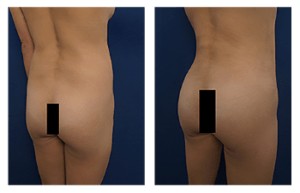
Procedure: Buttock augmentation by insertion of a silicone implant in order to correct sagging skin and/or loss of projection of the buttock region.
Length: 2 to 3 hours
Anesthesia: General anesthesia
Place of Treatment: Office-based surgical facility, outpatient surgical facility, or a hospital operating room
Recovery: Patients may feel sore and fatigued for the first three days after surgery. Patients can usually resume light activity one week following surgery and return to work within two weeks of surgery.
Duration of Results: Buttocks augmentation surgery usually leads to a permanent enhancement of the buttocks and improvement in the natural (flank-buttock-lateral thigh) silhouette. Patients are usually extremely satisfied with the results and enjoy a lifetime of improved buttock shape and back torso balance.
Side Effects: Side effects are events that may be experienced by patients as a result of your surgery and should not be considered adverse events. Our patients are counseled regarding these effects and if experienced they are tolerable and often temporary in duration.
- Bruising/Swelling: Temporary bruising and swelling usually occurs after surgery and greatly diminishes within a few weeks after surgery.
- Numbness: Patients may have a temporary loss of sensation in the buttocks due to swelling after surgery. The numbness usually disappears within a few weeks after surgery.
- Scarring: Separate incisions are used to place buttock implants with the incision lines placed in the gluteal crease. Due to moderate degree of tightness in the buttocks region, incisions may be red for a few months, but incisions become less apparent over time and fade to a thin white line. It is important to acknowledge that smoking impedes the healing process and will result in more prominent surgical scars.
- Asymmetrical buttocks: An uneven appearance of the buttocks may result if the buttock is asymmetric preoperatively. Your surgeon will make all attempts to compensate for any asymmetry by using different sized implants when necessary.
Risks: Risks are unwanted events that may occur during or following surgery. These events are recognized as “complications” but their occurrence is minimized by appropriate patient selection, proper surgical decision making, effective surgical technique, and thorough preoperative and postoperative patient management.
- Sciatica, or pain along the back of the upper leg, may become apparent following surgery but this is usually temporary and subsides over several weeks to months.
- Migration of the implant may occur in theory following placement of buttocks implants although this is not a commonly observed event. Lack of migration difficulties is likely secondary to a tight intramuscular pocket created during surgery. Concerns of migration are intuitive to patients as they are concerned about “all the sitting” on their implants. Despite above concern, four weeks of avoiding prolonged period of “sitting” is adequate to establish implant position.
- Infection: An infection can occur after buttocks augmentation surgery. An infection may result in disruption of surgical incision lines, extrusion of implant, and may leave the patient with an open wound. Prolonged antibiotics and possible removal of the implant may be required to fight an infection and to prevent further extension of the infection. Risk of infection is minimized by using sterile technique, using intra-operative antibiotics, and sealing all incisions sites so that bacteria can’t get in through external contact. In addition, infections are less likely in patients who don’t smoke cigarettes or in smokers who quit smoking for at least 1 month prior to surgery. Finally, buttock implant infection can be minimized by avoiding unnecessary compression of the implant by sleeping on your stomach at nights.
- Pulmonary embolism: Blood clots may form in leg veins during any surgery when the patient is under general anesthesia. Patients with a leg vein clot will complain postoperatively of pain in their calves. Patient’s with this complaint should be taken seriously and treated if a vein clot is diagnosed. Early treatment of patients with a deep leg vein will avoid migration of leg vein clot to the heart and lungs causing pulmonary embolism. Even though pulmonary emboli are rare, pulmonary emboli are the leading cause of death after surgery. Pulmonary emboli must be detected early by performing a CT Scan and should be treated urgently.